
AI: Information Technology Innovation and Maslow’s Heirarchy of Cognition


“Never memorize something that you can look up.”
- Albert Einstein
AI is rocking the world in deep, not-yet fully understood ways. The entire global economy is being transformed; it’s like a bomb was dropped onto the world we knew, and we are anxious about how it will all re-settle and what places we will find for ourselves in the new paradigm – if any.
Viewed through the long lens of history, though, AI is less of a rupture and more the latest step in a long pattern of information technology revolutions that have, quite literally, changed the way we think. The arc here isn’t of human replacement, but rather the slow externalization of cognition.
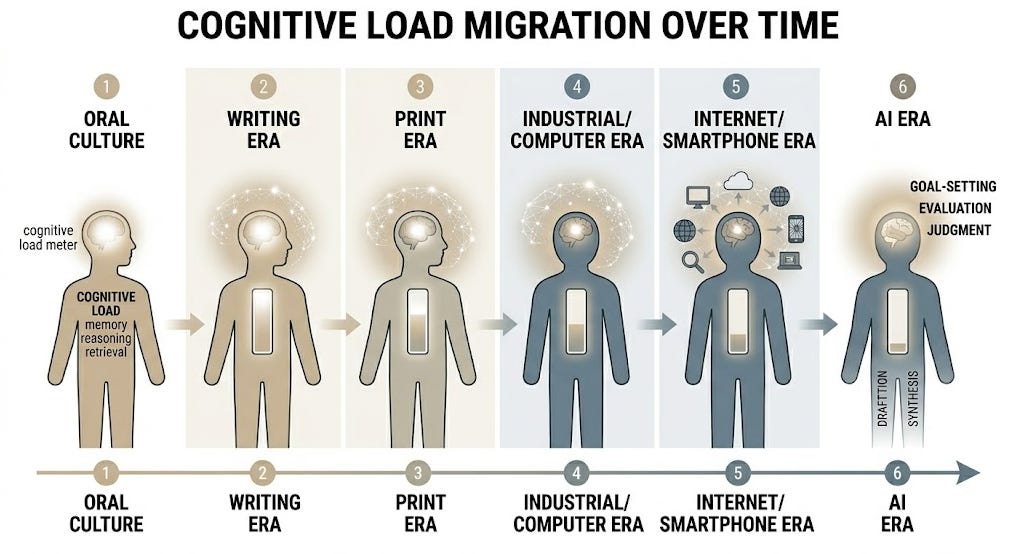
AI had it’s precedents – smartphones, computers, typewriters, the printing press, the written word. Each of these innovations were disruptive in profound ways, and each of them shifted the cognitive load, i.e. what type of thinking requires the most energy, and what types of thinking can get more focus as the cognitive burden shifts from internal to external.
When there’s a shift in what the labour market requires in terms of cognitive skill, work (and business models) have always shifted around them. A new balance is established and maintained until the next major innovation and subsequent cognitive externalization arrives. These transition periods are liminal – intermediary states between two models.
What we are living through now is just the latest of these liminal periods as we shift the cognitive load once again. When we look at what’s happened before, we can identify a pattern that gives us some sense of what to expect next.
Tools don’t replace cognition – they relocate it
Three things happened during each major information technology shift we have experienced:
A heavily-used cognitive function becomes cheap or automatic
Jobs built around that specific function shrink or disappear
New work emerges in the next level “up” in cognitive abstraction, similar to moving up a level in a Maslow’s Hierarchy of needs (except here, a Maslow’s Hierarchy of Cognition)
This is what we are experiencing and wringing our hands about now - not some some startling new societal trauma, but the latest iteration of a process that’s been going on for ages. It’s been happening since Plato decried the written word.
The pattern is thus – we don’t stop doing the work, we just stop doing it in the places we were used to doing it.
Writing externalized memory. Despite Plato’s fears, this didn’t stop us from remembering things altogether; instead, it allowed us to extend our retention for more things and, even better, opened up whole new worlds of information we could access without needing to keep it in our heads.
Printing externalized copying. The individual artistic character of, say, an illuminated Bible might have become more boutique than common place, and the transcribers of yore found themselves looking for new things to do, but think about what horizons opened up to us. The sharing of text became less energy-intensive, and as a result, cheaper – meaning exponentially more people had access to knowledge, and a whole breadth of knowledge, than could even have been thought possible in previous eras.
Computers externalized computation. Yes, there’s something to be said for learning your arithmetic tables, but with the advent of calculators, anyone could become a mentat with the help of a handy little box that could fit in your pocket. That meant more people could calculate, and therefore do all the things that require calculation.
The Internet externalized retrieval and coordination. For those of us who have lived through the rise of the Internet, we can remember the hours spent in libraries trying to sort through Dewy Decimal Systems to find books we then had to review to see if they had anything useful, and if they did, had to take them out and lug them around for a week before returning them. Now, I can start with a concept and find an incalculable wealth of resources ranging from books to journals to blog posts, and do it on a device that fits in my pocket in almost no time at all.
With each new information technology, there has been a concern of people losing a traditional ability that was really, really important. What happened in practice is that, with each innovation, cognitive effort has been externalized, and more people have had access to the next realm of cognitive possibility as a result.
Fear the Matrix – the end of thought
This has been something I have been fascinated with for a long time; the fear we human beings experience in the face of major innovative disruptions is the same, every single time. People worried that trains would do crazy things like cause the human body to disintegrate above certain speeds, and that exposure to rail systems would lead two-headed livestock (it’s true! I heard from my neighbour that his cousin one state over saw it with his own eyes!). There are similar urban legends around things like windmills today. While each of these things do disrupt our way of life in fundamental ways (think country mouse, city mouse), the worst of our fears never manifested – but they did keep coming back, almost like a rhyming couplet.
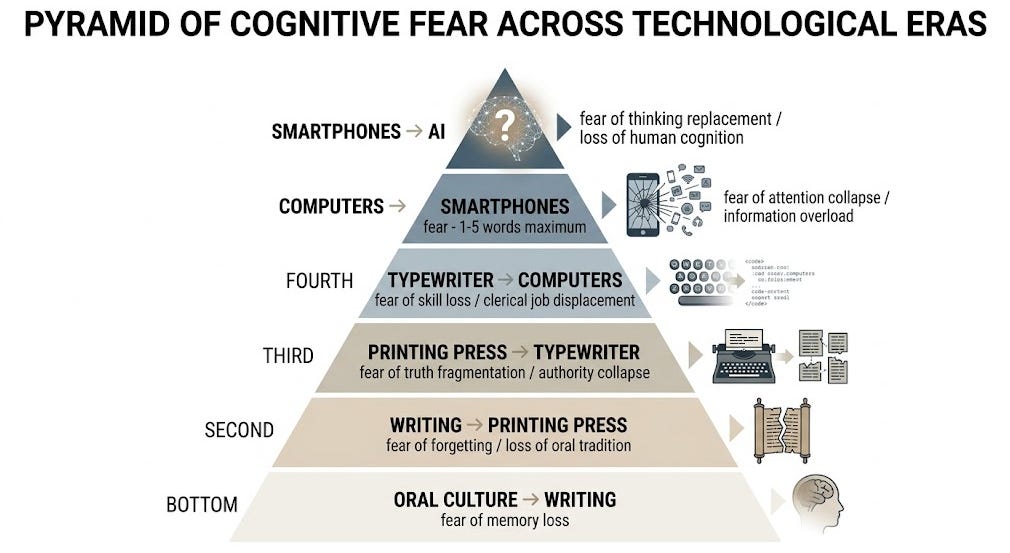
If we revisit the possibilities each information technology unlocked, we see a matching fear about what it would take away from what we humans had, almost as a birthright:
Writing would cause memory decay
The Printing Press would lead to the collapse of truth and a breakdown in authority
Typewriters and calculators would lead to deskilling and a “dumbed down” generation
Smartphones would spark an irrevocable collapse of attention
AI will replace thinking itself
With each transformation, we have assumed that the displaced function was a core human capability, and that the new tools would somehow erode our humanity.
It’s not an irrational fear, especially when you are going through the transition and trying to figure out what to do about your job, or how to best support your kids through school. In hindsight, though, each fear has been largely unfounded, and instead, what we have experienced is not a loss of capability but an augmentation of capacity.
Maslow’s Hierarchy of Cognition
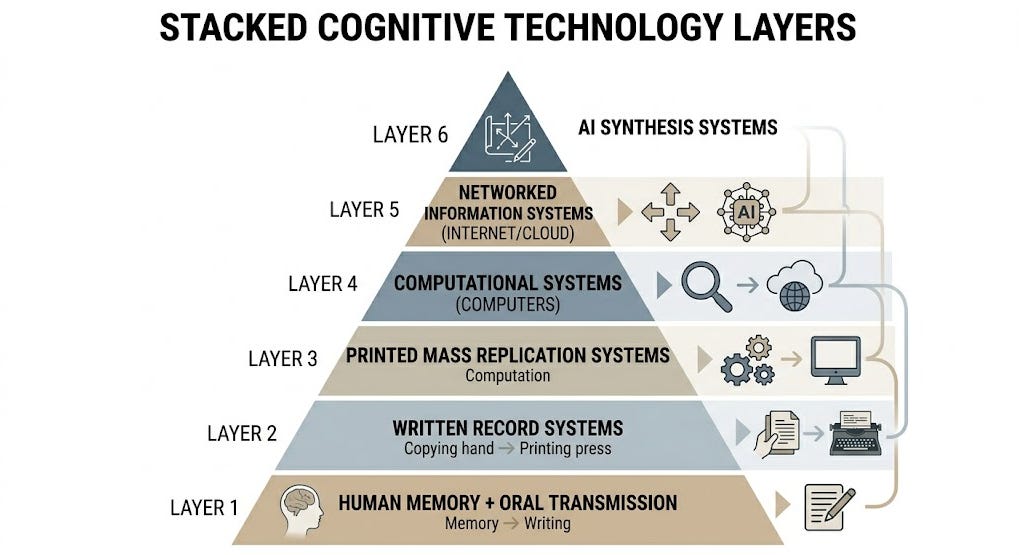
These infotech innovations can be viewed through the lens of job description; they can also be viewed through the lens of scarcity relocation.
Once a cognitive function becomes cheap, it ceases to be a valuable function of labour. What becomes valuable in its place is the type of thinking that resides one level up in the cognitive hierarchy:
an emphasis on memory shifts to an emphasis on interpretation
a focus on copying is replaced by a focus on editing
a simplification of computation allows for a focus on systems design
resources used for drafting can be reallocated to direction and evaluation
And where AI is concerned, what we are increasingly seeing is:
· a focus shift from generation to judgement
· an emphasis on production shifting to an emphasis on governance
· the weight given to output being given to outcomes and design
It’s absolutely true that entire sectors are being disrupted and jobs are being cut. That’s part of what happens in these liminal phases. What is also happening is a lot of quiet transformation that is shifting the energy required to do certain cognitive tasks, allowing us to reallocate that energy to higher orders of cognitive tasks.
Plato’s Boardroom: When production collapses before understanding internalizes
I use the term Plato’s Boardroom to refer to our very human tendency to use new things to solve old problems before we catch up to what the new tools allow us to do. An example of this where AI is concerned is some corporate leadership looking at how to replace human labour with this new tool, rather than considering how AI can free up their human capital to spend more time doing new things.
In this early stage of our current liminal infotech phase, production roles are being quickly compressed before new governance models have been defined, much less implemented. Intuitions, being run by humans who forged their careers and insights on the previous model, struggle to adapt to the speed at which changes are happening.
Again, we’ve been down this road before:
There is always a gap between what can be produced and what is socially understood and accepted as valuable work.
We are rooted in what we know. What we know is changing. We have new tools that we understand through their ability to do what we have been doing cheaper and more quickly, but we also recognize there are as-yet-undetermined impacts these new tools (and how we are using them, ie to cut labour costs) still rolling out.
This leads to disruption, anxiety, a massive impact to the current labour models and, couching it all, a scarcity of clarity.
Remember – across all the infotech revolutions we have gone through, the direction has been consistent:
from remembering → to recording
from copying → to distributing
from calculating → to automating
from drafting → to orchestrating
AI isn’t doing something completely unprecedented – it is building on the established pattern:
AI shifts the focus from doing cognitive labour to directing cognitive labour
As we work through the kinks of this new paradigm, we will see a shift in what we consider valuable human cognitive labour:
Deciding what matters over doing it
Defining constraints and goals
Evaluating outputs for reflective accuracy and deeper meaning
Integrating across domains as we need to spend less time elbow-deep in one
Maintain coherence across systems of machine output
This isn’t the end of human cognitive labour – it’s a relocation of cognitive authority.
I’ll give you a brief example.
World Building
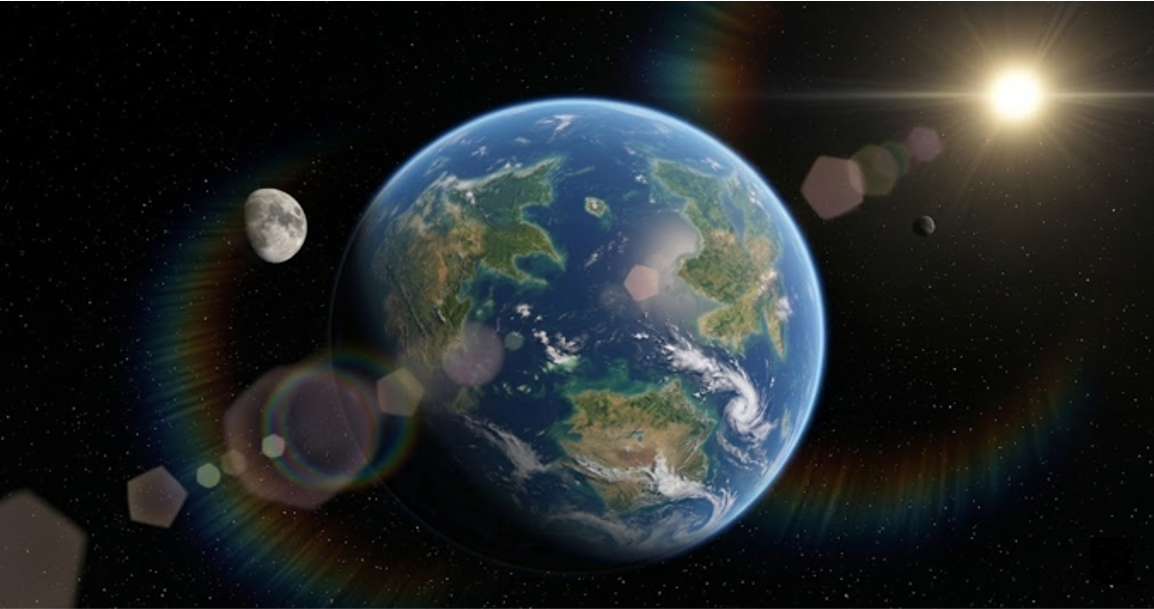
I’m a creative writer, and I love world-building; think things like Lord of the Rings or Star Wars. I’m not a philologist, nor an engineer, nor a graphic designer, so there have consistently been limits on what I can create. A George Lucas built his career in a direction that allowed him to hire people to expand his vision; he was trusted with capital and externalized elements of his world-building into ILM, Skywalker Sound, etc., and those external assets let him create an entire universe of characters, histories, mythologies and values, technology, colour palettes, etc.
I could never have done anything close to that even a few years ago. Now, with the use of a few AI tools, I have just completed the creation of a fictional world, starting with the formation of its solar system down to the present-day geography, topography, weather and currents, etc. On top of this I am building a layer of organic evolution, migration patterns, material culture reflective of available resources determined by how the world was formed, etc.
Couldn’t do anything close to realizing my vision on my own, but with ChatGPT? It’s like having my own Lucasfilm, my own JRR Tolkien and my own Neil deGrasse Tyson - without having the budget for any of them.
There are, without question, profound disruptions having for current professions; this doesn’t mean the end of the work these professionals do, but rather a shift in what roles will be valued and monetized.
Let’s explore this with two professions taking a hit with the rise of AI: Graphic Designers and Language Translators/Interpreters.
The future of Graphic Design
Again, through the long lens of history, we can follow the progression of graphic design as innovations have shifted value (and willingness to pay for) through the spectrum of processes:
Craft production → software era → template era → AI era
Each innovation has reduced the cost of execution. What AI, specially, has collapsed in terms of production costs are first drafts, concept exploration, variant generation and stock-style production work. Consider the energy and time costs these used to require as bottlenecks in the work flow. With AI, the bottleneck has shifted further from production towards visual intent, coherence, and creative judgement.
The profession of graphic design isn’t disappearing entirely; rather, it is becoming increasing stratified:
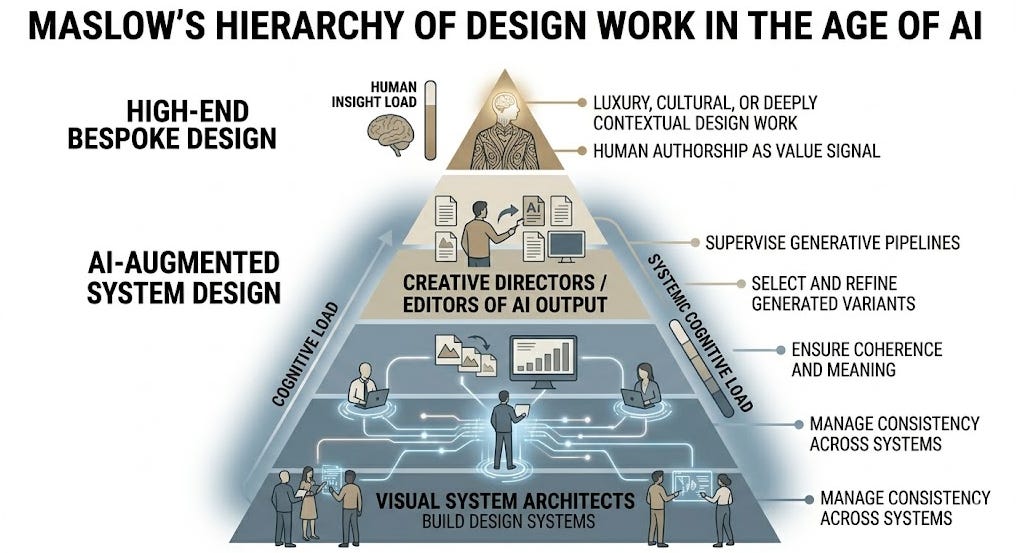
The business model continues to shift as the economic centre of gravity move from:
Deliverables → systems
Production → governance
Per-piece work → ongoing oversight
As the shift progresses, the designer becomes less a direct producer of artifacts and more a curator of visual intelligence.
My guess is that we are going to increasingly turn to professionals who serve as artistic sommeliers, helping us to curate and match what we need for who we are trying to reach.
The Art of Interpretation
Translation and interpretation are even more structurally exposed to the evolution of AI because it sits closer to pure cognitive transfer. Even the Apps that were created to serve translation roles are becoming obsolete as newer AI tools can do what it used to take a handful of Apps to do.
The art of translation used to be manual task, done by hand painstakingly by experienced professionals. Machine translation began to fill this role – imperfectly, but instantly. Now, with AI translation, I can get a near real-time semantic conversion, and even an accent-appropriate auditory version to listen to.
AI is compressing lexical conversation, sentence restructuring, and first-pass semantic mapping. It’s no longer difficult to be any random person on the street and, with a couple pokes at your Smartphone, have near-instant and incredibly accurate language conversion.
Is AI then sounding the death knell of the language translation/interpretation industry?
Personally, I doubt it. Language conversion, you see, is not a mathematical conversion of metric to imperial; if that was the case, a joke would land just as well in English as it would in Japanese or Quechua. Which is doesn’t.
Language itself was an innovative information technology that allowed for the transfer of complex data from one mind to another. Words are boxes for concepts, be they spoken or written; they allow for a broader sharing of concepts, but beneath those words is depth, meaning, feeling.
The true art of interpretation and translation isn’t to convert words from one language to the next, it’s to encode meaning in frameworks that align with the sensibilities and experiences of the person or people being served.
This critical piece of meaning transfer exists at a higher order of the Maslow’s Cognition Hierarchy, and its not one that AI is positioned to master (yet). As such, the role of translators/interpreters isn’t going to go away; the value of the human labour involved is, rather, going to shift gears.
I imagine the next iteration of the Translation/Interpretation industry will look something like this:
Linguistic Oversight Officers
Think the sectors where clear interpretation is absolutely critical, but isn’t as prevalent as it should be – legal, medical, trade, etc. The Subject Matter Experts who can ensure the words reflect the meaning will be more valuable – and, as training and role definition catches up – more universally available. AI will make interpretation more available, but LOOs will play the critical role of validating those interpretations, something that we will continue to emotionally need regardless of the quality of the mechanical transfer from one taxonomy to others.
High-Stakes Human Interpreters
A variant of Linguistic Oversight Officers that take on the emotionally fraught and high-consequence interpretation situations; diplomacy, conflict negotiation, that sort of thing.
Cross-Culture Communication Designers
This is where the oft-vaunted “user experience” piece maps on to knowledge/meaning transfer. These specialists will have a deep understanding of the cultural coding that underlies words and play a critical role in designing communication architecture to ensure meaning and intent aren’t lost (as they are, constantly, not just between languages, but between segments of a society that all speak the same language).
The interpretation/translation industry’s entire business model will shift profoundly in the same ways many sector’s models will shift:
per-word style translation will give way to risk and accuracy governance
output generation will shift to verification and liability management
and, my personal favourite -
linguistic labour will refocus on trust infrastructure
Read that last one a second time. Along with all this technological revolution, we are experiencing a profound loss of public trust in the institutions of society, ranging from government to corporations. Even within organizations, the complexity of work and the required fragmentation of that work into sector-specific silos is making it harder to communicate vertically and laterally, between producers and consumers, between departments, between the governing and the governed.
Our society isn’t broken; it’s simply evolved to a point where we need a new function that specializes in inter-silo communication and the trust architecture (the interpretation of intent) needed for that to happen.
I guarantee there will be jobs opening up in that space in the near future.
Whether we look at Graphic Designers or Interpreters or any other sector impacted by AI, the trajectories are pretty consistent:
Human produces output directly → Tools accelerate production → Systems standardize output → AI automates first-pass generation → Humans move into oversight and judgment
It’s not at all surprising to me that there’s a whole movement around Modern Leadership; as AI allows for a greater shift in human labour from production of work to governance of work, we are all going to have to up our leadership/governance game.
Think what that will do to civil society and democratic engagement.
Parting thoughts
If the pattern established by literally all of recorded history is anything to go by, we should expect the current labour market disruptions to start resolving into the next higher order of emphasis on cognitive labour:
fewer roles creating first drafts
more roles centred on selecting, validating, and directing outputs
increased value placed on judgement, taste, and context
growing importance of system design over task execution
Instead of looking for the best product, we are going to be turning to product sommeliers who will help us determine the right products to pair with our needs and contexts.
Instead of leaders who manage labour, product and policy, we are going to look more for curation – social gardeners, if you will.
And, while there will be jobs lost and markets disrupted, what will emerge on the other side will also follow the trend lines of history – and if you’ve read this far, you already know what I believe the future holds.