AI: Information Technology Innovation and a Hierarchy of Cognition
The "ChatGPT, please edit for AI policy/HR/leadership consumption" version

“Never memorize something that you can look up.”
— Albert Einstein
Executive Summary
AI is often framed as a discontinuity in labour markets and cognition. Historically, however, it is better understood as the latest stage in a long sequence of information technologies that externalize cognitive functions.
Across these transitions—writing, printing, computing, the internet—three consistent dynamics emerge:
Core cognitive tasks become cheaper or automated
Labour markets built around those tasks contract or transform
New value shifts upward into higher-order cognition (judgement, design, governance)
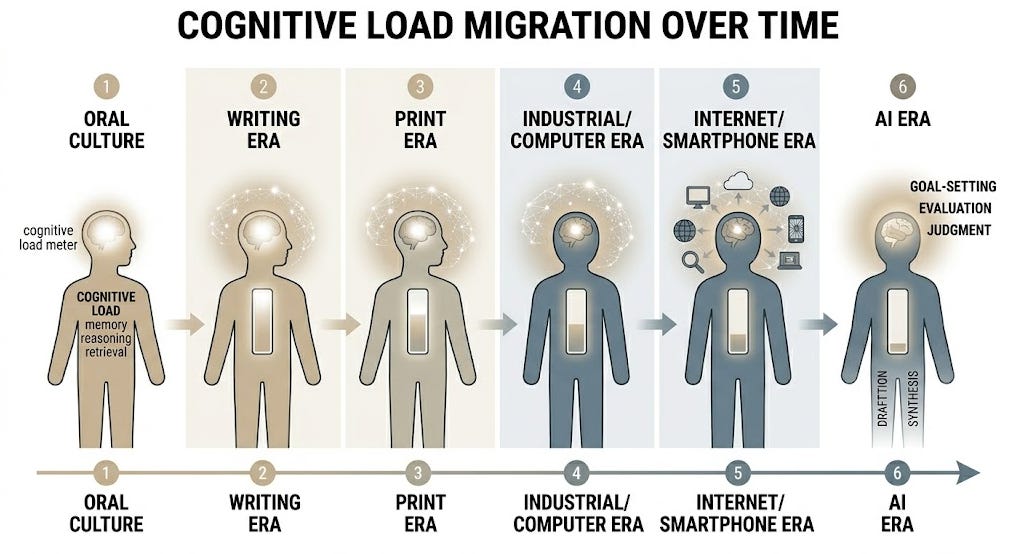
AI accelerates this pattern but does not fundamentally alter it. The central shift is not the replacement of human cognition, but its relocation—from production to oversight, from execution to governance, and from task completion to system design.
1. The Long Arc: Externalization of Cognition
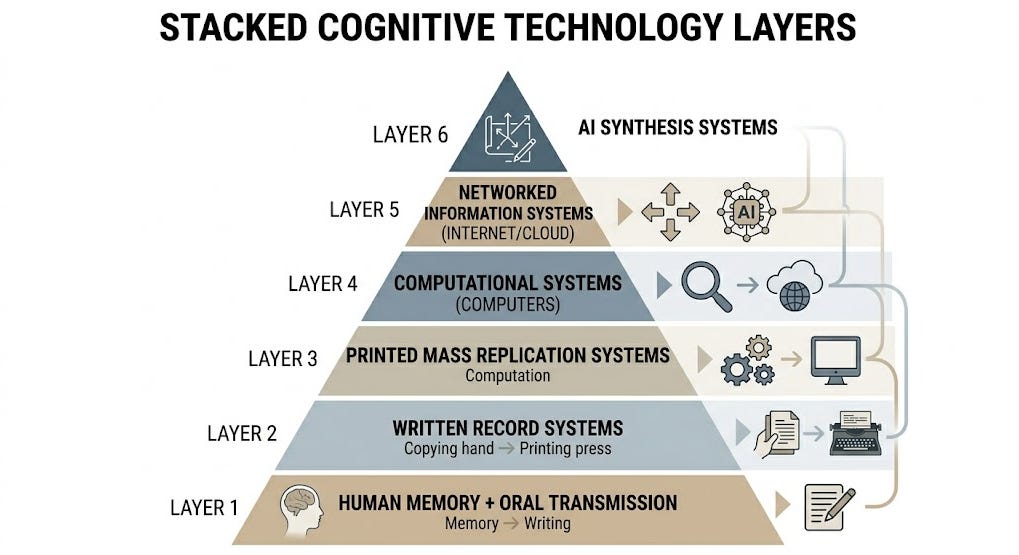
AI is best understood in continuity with prior information technologies:
Writing externalized memory
The printing press externalized copying and distribution
Computers externalized calculation
The internet externalized retrieval and coordination
AI externalizes first-pass cognitive production (drafting, synthesis, generation)
Each wave reduces the cost of a previously scarce cognitive function. The result is not cognitive loss, but cognitive reallocation.
Historically, transitions of this kind produce predictable instability in labour markets, followed by structural rebalancing.
2. A Recurring Pattern in Labour Transformation
Across each major transition, three consistent effects appear:
A once-valuable cognitive function becomes abundant
Roles centered on that function are devalued or compressed
New roles emerge at a higher level of abstraction
This can be understood as a “hierarchy of cognition”: as lower-level tasks are externalized, human value shifts upward toward interpretation, coordination, and design.
Examples:
Memory → interpretation
Copying → editing
Calculation → systems design
Drafting → orchestration
AI extends this same pattern into generative cognition.
3. Current Transition: From Production to Governance
AI systems reduce the cost of producing plausible first drafts across text, image, code, and analysis.
This shifts the binding constraint in most knowledge work from production capacity to:
Judgement (what is correct, useful, or appropriate)
Direction (what should be produced and why)
Governance (how outputs are constrained, evaluated, and deployed)
Integration (how outputs function across systems and domains)
The key transition is:
from doing cognitive work → to directing cognitive work
This has direct implications for organizational structure, labour demand, and institutional design.
4. Transitional Instability: The “Plato Gap”
As with prior technological shifts, there is a lag between:
What tools can now produce
andWhat institutions can reliably evaluate, govern, and integrate
During this phase, organizations tend to default to using new tools to replicate old workflows (e.g., cost reduction via substitution), rather than redesigning systems around new capabilities.
This produces a predictable mismatch:
Production capacity increases rapidly
Governance frameworks evolve slowly
Labour displacement occurs faster than role redefinition
This gap is not new; it is a recurring feature of technological transition periods.
5. Sectoral Impact: Structural Compression of First-Draft Work
Certain categories of work are more exposed because they sit closer to “first-pass cognition”:
Draft production
Routine translation
Template-based design
Basic summarization and synthesis
These roles do not disappear uniformly. Instead, they stratify:
1. Automated layer
First-pass generation becomes machine-led
2. Human oversight layer
Judgement, validation, correction, and contextualization become primary value-adds
3. System-level layer
Design of workflows, constraints, and evaluation systems becomes central
6. Emerging Labour Re-composition
Across affected sectors, value shifts consistently toward:
Judgement over generation
Systems over outputs
Oversight over production
Risk management over execution
Integration over specialization
In practical terms, this produces a reallocation of human labour toward:
Defining goals and constraints
Evaluating outputs for coherence and correctness
Managing cross-domain integration
Ensuring accountability, safety, and interpretability of systems
7. Illustrative Case: Language and Design Work
Translation and Interpretation
Machine systems increasingly handle lexical and syntactic conversion. However, meaning is not reducible to word substitution. It includes cultural context, intent, and risk-sensitive interpretation.
This suggests a shift toward:
High-stakes human interpreters
Oversight and validation roles in legal, medical, and diplomatic contexts
Cross-cultural communication design functions
The core economic shift is from:
translation as output production → translation as trust and risk infrastructure
Graphic and Visual Design
AI reduces the cost of ideation, iteration, and variant generation. This compresses the value of production-heavy design work.
Emerging value concentrates in:
Art direction and intent specification
System-level visual coherence
Brand and narrative governance across media
Selection, curation, and evaluation of generated outputs
Design becomes less about artifact production and more about managing visual systems.
8. Broader Institutional Implications
As AI reduces the cost of producing outputs, institutions face a structural inversion:
Output becomes abundant
Interpretation becomes scarce
Trust becomes the binding constraint
This has implications beyond labour markets, including:
Regulatory design (verification vs production standards)
Corporate governance (oversight of AI-mediated workflows)
Public administration (decision legitimacy under automation)
Education (emphasis on judgement and synthesis over recall)
The central challenge is no longer access to information or production capacity, but the governance of increasingly cheap cognitive output.
9. Conclusion
Historical precedent suggests that AI is not an endpoint of human cognitive labour, but a continuation of its externalization.
Across every major information technology transition, the direction of change has been consistent:
From remembering → recording
From copying → distributing
From calculating → automating
From drafting → orchestrating
From producing → governing
AI extends this trajectory.
The critical policy question is therefore not whether cognitive labour disappears, but how societies redesign institutions to support:
higher reliance on judgement
expanded governance capacity
and new forms of accountability in systems where production is no longer the limiting factor
The shift underway is not the end of cognitive work, but its relocation into higher-order functions of direction, oversight, and system design.