
The American Experiment

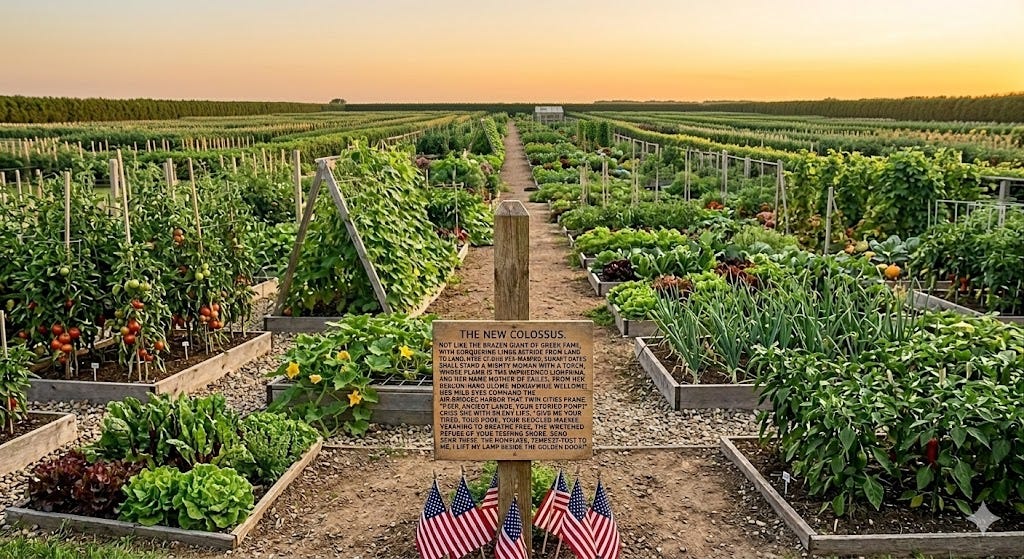
“Give me your tired, your poor, / Your huddled masses yearning to breathe free.”
- The New Colossus, Emma Lazarus
These words are engraved on a bronze plaque mounted inside the base of the Statue of Liberty, one of the most iconic symbols of the United States of America. For 250 years, these words have formed part of the American Identity, aligning with the capitalist model and the notion of the American Dream — that anyone, with hope and hard work, can find success in the USA.
I’ve been thinking a lot about these words of late, not just in the context of the current US administration, but in geopolitics writ large. There is a fundamental truth within this vision that remains as powerful today as when Lazarus wrote The New Colossus in 1883; it’s one, unfortunately, that Western society has strayed from.
So, at this moment of deep uncertainty that we are in, where it seems like there are few paths for success and that they are limited to a but an increasingly small pool of elites, it’s worth revisiting exactly what was the dream behind the American Experiment.
First, a bit of context. The current President of the United States, one Donald J. Trump, consistently frames himself as the holder of all answers, the embodiment of wisdom, the Philosopher King. As part of his working model, he uses tried and true, divide-and-conquer, coalition-building, fight-picking political tactics. There are good people and bad people, and the good people are on his side. The bad people are those who challenge him and his people, and therefore must be silenced, removed, or kept out, like a virus. Whether it’s Democratic Senators or Somali immigrants, the message is the same — we are good/smart, they are bad/stupid, I alone can protect us from them.
Trump’s approach is a caricature of top-down, divisive politics, but it’s not unique to him. You can find variants of the same model across the Western World, including in my own country of Canada. While our political divisions aren’t as extreme as they are in other countries, we do see a lot of us/them framing in Canadian politics, with “you need us to fight for you against them” as a common talking point. whether you’re on the right, left, or in the centre of the political spectrum. Having played various roles in politics over the past couple of decades, I’ve seen this hardening of lines become more prevalent, to the point where it is less likely for political adversaries to be friends - something that was common when I started my political career in the early 2000s.
An important parallel trend to note has been the increased centralization of power in the offices of Premiers (leaders of Provinces) and Prime Ministers. This centralization of power and the need to curry favour from/back the Centre to win puts pressure on party members to fall into lockstep with the leader and their team. Even in backroom conversations with political operatives, the message is that the party has to get behind the leader because the leader is the fulcrum around which the party, electoral success, and political agendas rotate.
I absolutely believe that these two trends — the tribalization of our politics and the consolidation of power within the hands of one person and their office — go together. In talks I have given about Open Government, I have used the analogy of the Premier/Prime Minister becoming the new monarch, with the political apparatus around them in the Premier’s or Prime Minister’s office increasingly resembling the King’s privy council of old. Rather than independent representatives of their constituents to government, Members of Parliament have almost become vassal lords to partisan factions and leaders, with their ability to hold on to their constituent fifes due in large part to the support of their party Centre.
If you were to ask the average Canadian which party leader they would vote for in the next election, I can almost guarantee that the vast majority won’t point out the fact that they can’t vote for Prime Minister or Premier — because that’s just not how our parliamentary system works. We vote for our local representative only — not a party, not that party’s leader. We may prefer a representative be from a specific party; we may prefer a specific party and vote for whoever represents them. When we make it clear to our local candidates that we are picking them based on their party leader, we disempower our own local voice by ignoring the structural intent of our parliamentary system.
The system we have in place — the Westminster Parliamentary System — is over 800 years old. It replaced an absolute monarchy with a constitutional framework. The reason we refer to members of government as “Ministers of the Crown” and “Prime Minister” refer to the fact that these roles were, originally, in direct service to the crown. The monarch had ministers, with one “Prime” Minister to oversee them, and that monarchical government was held to account by, at first, the landowner class, and over time, the nation at large.
To this day, it is by convention only that the King or Queen’s Cabinet is pulled from the ranks of Parliament; it is not a legal necessity. The role of Parliament, originally, was to hold the Crown to account. Over the centuries, democratic pushes and conventions established over time have led to a model whereby the Members of Parliament that we are most likely to elect are as much representatives of a given political party as they are of their own constituencies. Aligning with one political party or another isn’t just a way of joining a caucus of like-minded policy makers; it’s a way to tap into the brand and election machinery that those political parties have. There’s a reason it’s hard to be elected to Parliament in Canada as an independent; the power of the party plays an outsized role.
The result is that, in the present day, we have parliaments largely dominated by blocks of party representatives that operate under a mandate of becoming government, rather than holding it to account. Some might say this is a good thing, as the competition forces structural challenges and ideas to the fore; at the same time, though, when the goal is to win power, and doing so means mobilizing money and specific coalitions of voters, some issues will inevitably rise to the top over others. Sometimes, this is because of broader societal impact; in a lot of cases, though, it’s about where the money and the votes are. If you have heard the line that youth issues don’t come up much in our politics because youth tend not to vote, but seniors vote in large numbers so their issues dominate, that would be why.
By now you’re likely asking: “What does all this have to do with the huddled masses?”
I’ll answer the question by first posing another one — why would a nation want to bring in the tired, the poor, the huddled, the wretched? From an objective point of view, inviting tired poor people to your country feels like taking in a stray that will require a lot of work and take up a lot of resources. It creates yet another coalition that will compete for power and influence on policy, weaking the influence of you and yours.
This is the argument that Donald Trump makes; we don’t want people from shithole countries, we want people who bring success WITH them to our country. In his view, there are good countries with good people, and bad countries with bad people — it’s a fundamentally racist perspective completely devoid of any sense of geopolitical history, but it also flies in the face of the American experiment.
Here’s where we tie it all together.
Our politics, as exemplified in exaggerated form by Donald Trump but present throughout the Western World, has increasingly raised the cult of the Leader and the Partisan. Even when we have no practical ability to vote for a leader, we convince ourselves that’s what we are doing, and the political party operatives do nothing to discourage this. This lends itself to viewing our communities through the lens of political blocks, of our issues vs their issues. More people not part of our block means more competition for the policy attention of the government, and that because of competing influence over which party rises to the top.
We aren’t voting for representation; we are voting for power.
The corollary of this is that we are, unintentionally, undermining the foundational systems and intent of our democracies - which, I believe, is a big part of why so many people are questioning the viability of those democratic models entirely.
Back to my question — why should we want to welcome the poor, the tired, the huddled into our homeland? Don’t they drain away from the resources we have, and weaken the coalitions and power structures we are used to? Don’t they take away from what makes us great, and threaten our ability to get the guys we want into power?
The way we are choosing to look at our governance and our leaders is hyper-focused on the powerful people who will wield power on our behalf. It’s quasi-monarchical in its framing.
The same basic principle is present in the for-profit sector as well; the people who rise to the top are the best people, the wisest, the most successful. We can trust them because they won at the game of life.
They are the winners, so it makes sense to invest in them. When we do that, good outcomes will trickle down to everyone else. We keep playing this game, and yet more and more people are frustrated that these winners don’t seem to be living up to the trickle-down part of the bargain. If anything, the more we invest in a few winners at the top, the more the rest of society seems to be atrophying. There are winners and losers, and the role of the people, increasingly, is to support them based on how winning they are.
Here’s another quote you might have heard in passing:
We the People of the United States, in order to form a more perfect Union, establish Justice, insure domestic Tranquility, provide for the common defence, promote the general Welfare, and secure the Blessings of Liberty to ourselves and our Posterity, do ordain and establish this Constitution for the United States of America.
Those are the opening words to the United States Constitution.
WE the people. Justice. Domestic Tranquility, common defence, general Welfare, Blessings, Liberty, Posterity. (They liked to capitalize certain words for emphasis back in the day).
The reason the United States of America was willing to welcome the tired, the poor, and the wretched from any corner of the world was because, from its founding doctrine, America believed that all people were created equal (NOTE: their definition of “people” needed some work), and that all people were capable of great things.
This was the Unique Value Proposition of the American Experiment: all people can raise to great heights, and that the thing that allows for this isn’t a strong, powerful centre, but a system that invites participation and through participation, creates equity and opportunity.
It didn’t matter where you came from, what language you spoke or religion you practiced; the American system was designed to create a cycle of reciprocity, with the opportunity availed by the system empowering people, who would then pay it forward to their peers, on and on. It was the world’s easiest operating system; anyone could tap into and succeed, because the system was that good.
Centralized power wasn’t the answer, nor was cherry-picking winners from losers. The founding fathers were confident in the system they created, the constitutional framework that would allow for all people to succeed. The vision, though capitalist, was less about the law of the jungle or horse races or picking fights; the American Dream was a garden of fertile soil that created the space and infrastructure that would allow for each person to become the best contributor they could be.
The poor would find rich soil, and a chance to grow and produce fruits from their labour. The tired would find rest and new vigour to rise to new heights. The wretched would find a place to belong, and the encouragement to empower others just as they had been empowered themselves.
The American Dream had faith in people and believed its system was the best model available that allow all people to succeed. Not winners and losers, not good people and bad people, but the masses made free to build a better world together.
While not perfect, it’s been a pretty decent model for 250 years. People have indeed come from every corner of the world — even the countries that Donald Trump now denigrates — and contributed in building the most prosperous, powerful and free nation the world has ever seen.
America didn’t rise in spite of the tired, poor, and wretched — it rose with them. That was and always has been the secret sauce of the American Experiment. The fractures within the American model today aren’t because the wrong people are being given power or invited in, but because the fundamental, constitutional intention of America is being neglected, allowed to weed over.
If you look at history, this is a common story; in any given system, there will be people who seek power and work to gain it, leading over time to shifts in the system and an atrophying of the whole as power, wealth and privilege increasingly consolidate in the centre, at the top, among the few. The change is subtle, and the people who exist within the system will slowly start shifting in their beliefs and practices until it seems clear that the problem with the system isn’t structural neglect, but that the wrong people keep getting in power, requiring an increased partisan intensity to get the right ones in to restrict those who would take away from the commons.
The American Experiment posited that with the right system, the right infrastructure in place, everyone would rise. I still think that’s true.
When we have faith in people, and create the institutions that support them, nations thrive. The US certainly did for the past 250 years.
When we invest all our trust in leaders, parties, corporate successes, and lose faith in our institutions, we see people as the problem that holds us down or turns us into tired, wretched masses ourselves.
The American Experiment was, and remains, the least worst social model that humanity has yet devised. When it’s allowed to work, new people bring new ideas, adding fresh nutrients to the garden bed of society and allowing for new, healthy grow and innovation. The institutions serve the people. Leaders of those institutions never lose sight that theirs is a position, not an entitlement — that it’s not about them, but about us all - we, the people.
Give us your tired, your poor, your huddled masses yearning to be free — in this fertile land of ours, we will grow good things together.